
The mountain within
Wherever we are, we can always look up

Mountains move people in so many ways. One way they move people is to tell stories.
Here’s one.
When I was fourteen my Dad, a manager for Alberta Power, the electrical utility company, accepted a job transfer that took us from our home in Grande Prairie to the town of Jasper in the Canadian Rockies.
I did not want to go. I had friends. I had a crush on a girl at school, and any day now I was sure I’d find the courage to actually talk to her. But I was fourteen and I didn’t have much choice about where I lived. So my family uprooted itself and we moved to the mountains.
With accommodations being pricey and hard to come by in a place like Jasper, we had to take what we could get. This turned out to be a much smaller and older house than the one we’d lived in in Grande Prairie.
The transfer meant that my Dad’s salary increased, but the move had its hidden costs, in the strain it put on everyone in the family. We were coming to a place that, as an isolated little town that was also an international tourist destination, had its own unique challenges, and learning to navigate all of that would be a bumpy ride for each of us in different ways.
At the time my hometown of Grande Prairie was a growing city, undergoing one of its periodic oil and gas booms. Jasper, in contrast, was very much a typical small Alberta town, with the peculiar exception that during the summer, thousands of tourists flocked to it, and drove through it, and wandered around in it. This meant that prices for groceries, gas, and so on were artificially high. And there were other new temptations and dangers for teenagers like me: Jasper was also a hub of transient workers, hitchhikers, social drop-outs, with plenty of illegal drugs passing through town as well.
Besides the crowds, the other thing that Jasper had that Grande Prairie didn’t, was mountains. Little did I know at the time that it would be mountains that would turn me into a writer.
So, 1979. That fall I start high school in Jasper. One day I meet a girl—and actually talk to her!—she becomes my first girlfriend. In Jasper I try activities I never had the chance to in my hometown. I go on multi-day hikes, I ski, I rock-scramble, I encounter wild animals. I nearly die on an ice climb in Maligne Canyon for which I was stupidly unprepared.
One night at a party on the shore of Pyramid Lake I get stoned on booze and cannabis, and wander off by myself and lie down in the woods. I gaze up at the towering black spruce and the night sky, suddenly I can hear the trees speaking, in low, murmuring voices. The trees are talking, they’re talking to the stars, and the stars are talking back, in the same soft, drone-like tongue. There’s no doubt in my mind: the trees and the stars are aware and sentient, and holding a conversation. They’re laughing, too, it seems, maybe at me, at how small and pitiful I am. I can’t understand what they’re saying to one another, and I feel sad not to be included.
This event was an experience of what I call the numinous, about which I’ll have more to say later.
The teen years are intense and character-forming for anyone, of course. In my case the dramatic, angsty adolescent stuff I was going through happened in a landscape that felt equally dramatic and grandiose. The incident with the trees and stars was just one extreme example. All of the upheavals going on inside me seemed to find a corresponding upheaval in the towering, fractured massiveness of the landscape. I would go hiking alone in the hills and project my desires and humiliations into these wild places, which had ample space and silence to contain them. Unlike in town, where one had to bottle one’s feelings up and hide them.
It’s not surprising then, that I came to identify with the mountains. They were somehow part of me, or I was part of them. Or both.
I think this feeling of deep identification was pretty common for people living in Jasper. At the time I knew that many of the locals felt the same way. This sense of personal belonging showed up most often in a negative way, in the resentful attitude locals held towards the tourists. They depended on these visitors for jobs and prosperity, but they didn’t really like them. The derogatory slang term for a tourist in those days was “gorby.” In the minds of many of the local young people I went to school with, these gorbies were all incredibly stupid. They blundered around, gaping at everything and asking dumb questions, like “Who painted the top part of the mountains white?” All summer tourists clogged the sidewalks, creating traffic jams and paying ridiculous prices for stuff they could get much cheaper somewhere else. We teenagers mocked them and ridiculed them.
Sometimes we gave them false information. A friend of mine told the story of how a carload of tourists had stopped him on main street and asked, “Where’s Jasper?” He pointed west and told them, “Jasper’s down that highway about another hundred kilometres. Just keep going. You can’t miss it.”
It was odd—the tourists brought local people their livelihood, but the locals still resented them for their ignorant encroachment on “our” mountains. I think now that this ambivalence was the ungenerous side of a deeper feeling shared by pretty much everyone in town: that Jasper belonged to the people who lived there, that it was a deep part of their identity. I shared this proprietary attitude and I still catch myself thinking this way when I visit the park, all these years later. (“Too many damn tourists” I will complain, even though I am one). Despite the fact that I haven’t called Jasper home in decades, these are somehow still MY mountains.
In The Living Mountain,” her classic memoir of the Cairngorm Range in Scotland, Nan Shepherd writes: “Thirty years in the life of a mountain is nothing—the flicker of an eyelid.” That’s exactly how I feel about the peaks of Jasper. I look up at them now and they’re much the same as they were when I was fifteen. It’s as if I’m looking at my own past, at eternal monuments to vanished times and people who are long gone. They’re unreachable and yet at the same time they’re still here.
*
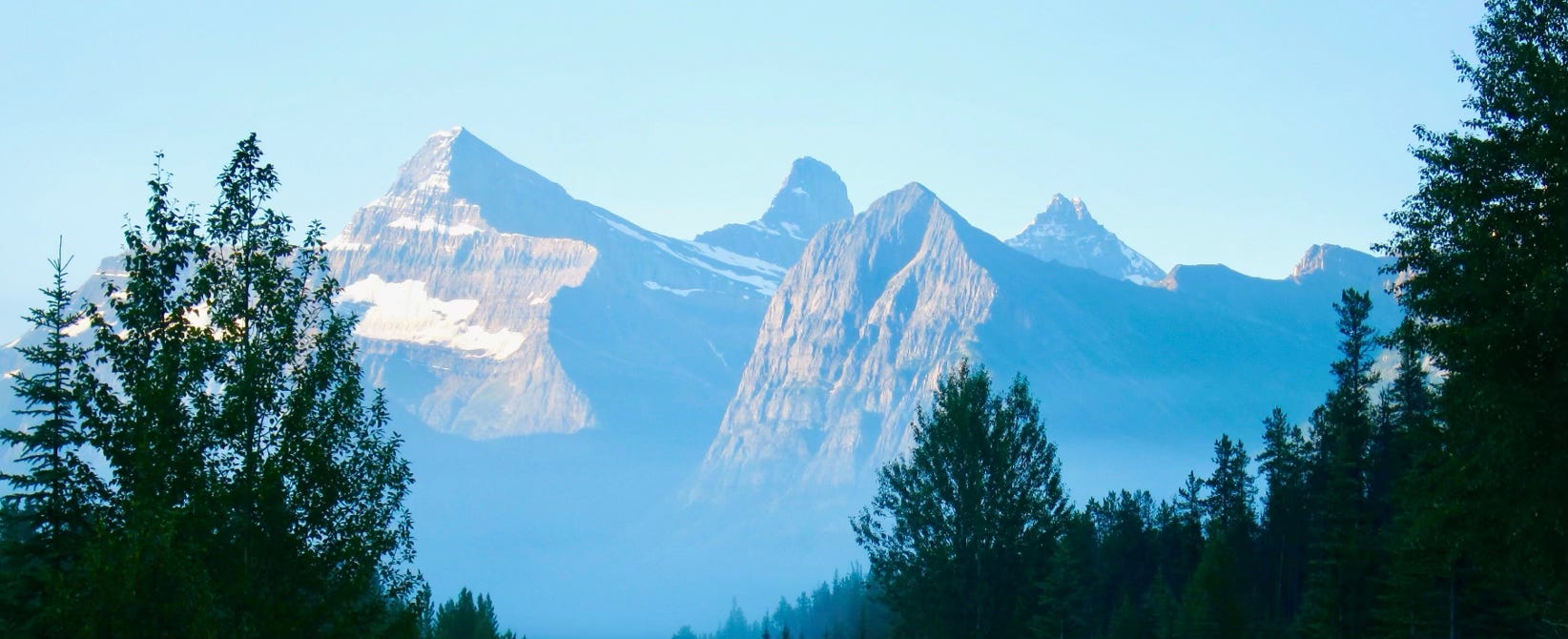
I want to focus on Mount Edith Cavell in particular as an exemplum of all this. Cavell is a spectacular, luminous wall of snow, ice, and rock that can be seen from town on a clear day. It changes colour and solidity and aspect from hour to hour, but it’s still always itself. Sometimes Cavell seems to hover in the air like a dream in broad daylight.
The mountain’s name among early fur traders was La Montagne de la Grande Traverse. And in the matter of naming mountains, as everywhere else, we can see colonial erasure at work. As I note in my novel Icefields, La Montagne was renamed Mount Edith Cavell during World War One, to honour the courageous nurse who saved the lives of British soldiers at the cost of her own.
But that earlier French name was itself already an erasure of whatever name the mountain may have been given by the Indigenous people who lived and traded in the Athabasca valley before Europeans arrived.
Long after moving away from Jasper I would dream about its landscapes repeatedly, and especially about Cavell. Often in a dream I would find myself there, climbing the mountain, looking for someone or something. I didn’t know who or what.
This recurring dream finally brought me back to the actual mountain, years after we moved away from Jasper. I knew there was no way I could climb Cavell itself. I’m not a climber. I learned on rock-scrambles and ice-climbs in Jasper during my teenage years that I just don’t have the nerve for it.
But I needed to go to Cavell, and go alone. So I set my sights on the high ridge alongside the peak, at the top of the steep upland known as Cavell Meadows. There’s a trail that ascends the meadows, but it peters out at a certain elevation. If you want to get to the summit of the ridge you have to scramble up scree slopes and sometimes trudge through patches of snow, even in midsummer. You can do this in running shoes, without gear, it’s not technically challenging, though it is risky of course if you’re unprepared ... and out of shape.
I finally made the climb one summer in my mid-twenties. When I staggered to the summit of the ridge at last, hyperventilating, I was seized by vertigo, followed by panic. There was the face of Cavell itself, towering before me across the empty air, like the naked face of a deity, terrifying and impossible. I huddled under an overhanging rock, trying to shut the vision out. What was I doing up here? It took me a long time to convince myself to crawl back down, slowly, to the safety of the trail far below.
Cavell scared the bejeezus out of me. It made me very small. Like the incident with the trees and stars, this was another encounter with the numinous.
And yet, that terrifying climb answered no questions. It didn’t reveal why I was dreaming about this place.
I only found the answer much later, when I was writing my first novel. My subconscious, all these years, had been trying to tell me what I should be writing about.
*
Back to the 1980s. My family moves away from Jasper and I start university in Edmonton. I enrol in Arts at the University of Alberta, majoring in English, and sign up for the English department’s creative writing courses, to learn the craft of becoming a writer.
But the stories I write at that time are not about Jasper. Not about mountains. I’ve left all that behind, or so I believe. I’m focused now on new experiences and on making something of myself, impressing my instructors with my serious writerliness. No more teenage angst. I nurture a secret ambition to write a great Canadian novel set where I live now, in Edmonton. I will pen the Ulysses of Edmonton.
I struggle at this. In these workshop classes I write almost exclusively about the city, or about incidents from my childhood in Grande Prairie, but they don’t fly. They don’t sing. None of these stories feels really “authentic.” They’re weak imitations of other, famous writers’ fiction. I have nothing to say about Edmonton, it turns out. And why would I? I’ve only lived here for a short time.
And then, little by little, as I keep at it, images of the mountains and the glaciers start to show up in my work, just as they’re still showing up in my dreams. These flashbacks and images of Jasper have emotional power, at least to me, though they aren’t yet stories as such. But they keep coming, and at a certain point the ice dam breaks, so to speak, and in the flood of insight I finally understand: Jasper, not Edmonton, is my material.
So I start gathering all these mountain memories and images, these fragments of personal history and lore and feeling about the mountains of my past. I still don’t have a story yet, though. And I need a story because this supposed novel-in-progress is also a Master’s thesis I’m working toward.
The brilliant Icelandic-Canadian writer Kristjana Gunnars is teaching in the department at the time, and I’m hoping she’ll agree to be my thesis supervisor. So I take all of this Jasper stuff to her. I apologetically confess that I don’t know what to do with this jumble of fragments. Kristjana looks at the material and says, “Fragments are wonderful! You can do so much with fragments.” It’s a bolt from the blue moment. I see that a novel doesn’t have to be written beginning to end, according to some pre-arranged plan. A novel can be stitched together or assembled like a jigsaw puzzle, only it’s a jigsaw puzzle without a picture on the lid of the box to show you what it should be when it’s finished.
Over time, as I revise and expand the fragments, I discover the connections between them and eventually find the central narrative thread they can be strung on. But I also let the finished novel, Icefields, retain some of its former fragmentary quality, because I want the story to reflect the landscape it’s set in.
I think of the novel as a moraine. A glacial moraine is a jumbled terrain of broken stones and boulders deposited by retreating ice, but these scattered stones and boulders do tell a story, if you’re patient enough to piece it together.
*
As one’s past recedes, it becomes a mythology. Memory becomes myth. By myth I don’t mean falsehoods but the stories that give shape to our lives. The stories we act out again & again. The past goes nowhere—it lives in us. It persists.
To me the mountains of Jasper are my past, my mythology. I age, but the peaks don’t seem to. They persist through time. And yet the mountains are so much more than just monuments to personal nostalgia. They are places of the numinous.
The idea of “the Sublime” is often used to describe the feeling of awe mingled with fear that mountain landscapes evoke. The concept is from the Romantic era, but over time it’s lost much of its meaning and depth. Now it’s a word for tourist brochures and visits to the spa. “After a hot stone massage, enjoy a sublime Canadian Rockies sunset from the deck of your $800 a night cabin at Jasper Park Lodge.”
For me, mountains are bigger than that. Scarier. Less knowable. A word that suits them better is numinous.
Numinous, the adjective, comes from the Latin noun “numen.” A numen for the Romans was a divine presence that reveals itself only at certain times and usually in out-of-the-way places. A spring or a wood might have its own numen. Or even a mountain. Although really, a single mountain is so vast and many-faceted a thing that it could surely host many numens, depending on the season, the weather, the time of day, which side of it you’re climbing, whether or not you meet a grizzly…
From this Roman idea of a spirit inhabiting a place we get our word numinous, which the dictionary defines as “supernatural, mysterious, spiritual, appealing to the higher emotions or the aesthetic sense.”
You can go looking for the sublime or the spiritual, but the numinous is something that finds you, usually when you least expect it. Often it’s attended by fear, by the wild and unpredictable. Like my moment of terror at Cavell, or the night I listened to the trees talk with the stars.
Mountains are numinous beings. They exalt, they terrify, they are far larger than we can encompass. They have a powerful presence that can shake you to the core. You know without any doubt how small and insignificant you are when you’re on a mountain, and that is a good thing to feel.
*
Akira Kurosawa’s anthology film Dreams (1990) is filled with eerie, startling images of numinous encounters in nature. The film tells several stories all based on unforgettable dreams the director himself had over the years. One chapter in particular that conveys the numinous as it manifests itself in mountain landscapes.
In this chapter of the film a party of mountain climbers slogs towards their lost camp through a howling blizzard. They can barely put one foot in front of another, just as in dreams one can find it nearly impossible to move. Their progress is so laborious and slow it’s painful to watch. Finally the men give in to their exhaustion and drop into the snow. One of them is approached by a beautiful woman who covers him in a ragged sparkling blanket and soothes him, telling him “the snow is warm ... the ice is hot.”
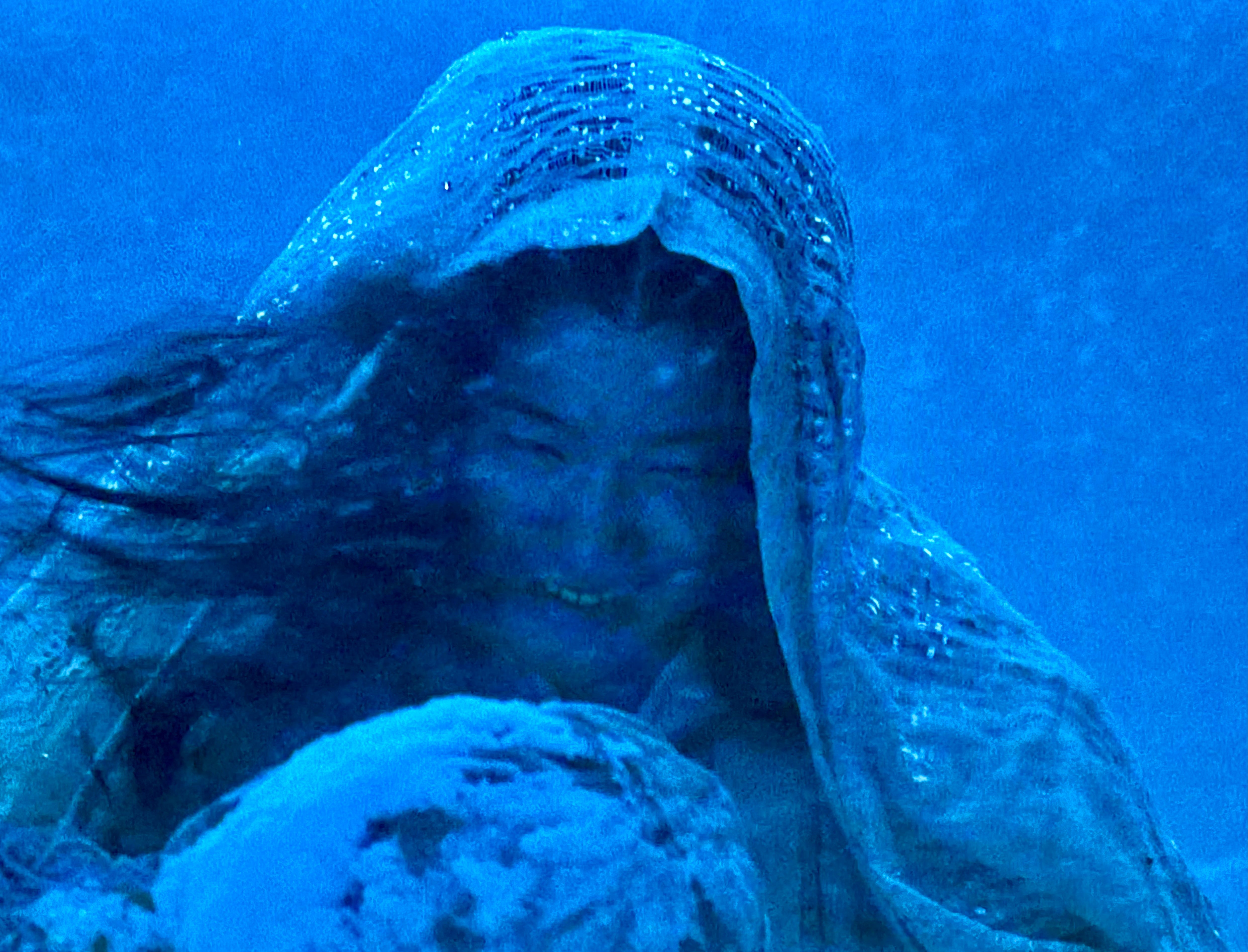
The climber almost gives in but then he struggles, fights back. The woman is unmasked, revealed to be a demon, a spirit of the mountain. With a crack of thunder the apparition flies away into the blizzard.
The climber rouses his comrades, and then the sun comes out, and the mountain appears before them in all its radiant beauty. They shout for joy—they can see their camp at last and they know they will survive.
Kurosawa’s imagery reminds me that a mountain is both death and life, and they are only a hair’s breadth apart. The same with terror and exaltation. A mountain will always be bigger than we are, but strangely, once we’ve met a mountain, it will always somehow be inside of us. Reminding us that we are also bigger than we know.
*
We think with the physical world. Because rivers flow, we can imagine other things flowing: time, electricity, conversations, history. Because plants grow, we can imagine the seeds of new ideas, we can speak of being rooted or uprooted, of turning over a new leaf, of our lives flowering.
Because there are mountains, we can look up.
This is so valuable as the world seems to shrink around us, getting increasingly linear, and flatter. We can feel reduced to a set of data points. The powerful of our time want to flatten us into fewer dimensions so they can more easily predict what we’ll do, extract profit from us, control us. Work, consume, scroll, stream, obey, repeat.
When we feel this happening we can close our eyes and return to the mountain. We can find the timeless vertical inside ourselves. We can look up, or gaze down, or out across the immensities we are.
This is why we need mountains.
[This essay is based on a talk I gave recently at the Edmonton Public Library, as part of the On the Edge: Making Mountains series, in cooperation with the Department of Atmospheric and Earth Sciences at the University of Alberta]
[Image ID: Peaks in Jasper at dawn, circa 2010, photo by the author]
I loved reading this, Tom! Love the personal history, the turning away from in fear yet never forgetting the mountains and how big a role they play in life and work. The mountain demon is truly frightening, but how cool to face her down and own the wild that’s really part of us — our source of inspiration and creation.
Thanks for this, Thomas. I have lived with the mountains for a long while, although, like you, I now don’t live in the mountains.