
Charm
What real things have that fake things don't.

As fake things proliferate and it feels like truth and authenticity are getting harder to find or hold onto, I’ve been trying to keep grounded by paying more attention to actual physical objects and experiences. Things that can’t be doubted, that machines can’t simulate or do for us. Yet.
Like eating a plum.
A plum is an undeniably real thing. Eating one is a real event. Some day a technology could be invented that will allow me to have a simulated experience of eating a plum. Would I be able to tell the difference? I don’t know. But for now, at least, when I eat a plum, I feel that I encounter a unique essence or quality that fake things just don’t have. For a long time I wasn’t sure if there was already a name for this essence. It’s not just physicality or tactility. It’s more like a combination of all the qualities a real thing embodies that unfold through time and that become part of us when we encounter it.
I’ve decided to call this elusive meta-quality charm.
Charm is usually defined as a kind of attraction, but not necessarily an immediate one. The person or thing who possesses charm might have to overcome some resistance in order to work their magic on us. We may be distracted, and so not quite see or feel the charm at first. And even when we do notice it, we might still hold back. We don’t like to give in. It could cost us a little extra effort. More and more these days real things seem to take extra effort, what with fake things having decimated our powers of attention.
Charm arises in real things because they don't reveal themselves all at once. It’s not that they won’t, it’s that they can’t. Real things have interiors, layers, facets, hidden sides, even to themselves. A person or thing with charm might not even be aware they have it. Which can also be part of their charm.
We can never completely know a real thing. We only ever know parts of it, but what we discover entices us to want to know more. That’s charm.
A plum from the farmer’s market is real.
A plum has charm.
I pick up a plum. I hold it in my hand, feel its cool smoothness. I turn it over to see the variations in its colours palette, from yellows to golds to red to deepening purple to almost black. I notice its imperfections, another reassuring mark of the real.
At first this thing actually repels me, just a little. To appreciate the plum I’ll have to make that initial effort to bite through its taut, glossy skin, and I hesitate. Do I really want my mouth to meet this thing? It almost feels like the plum hesitates too. Does this sealed-up, inviolate entity really want my teeth in it? I know I’m bracing myself for the tartness that’s likely to follow the first bite. I want that tartness and sweetness, but at the same time it’s a bit like plunging into cold water on a hot day—initially it might be a little unpleasant, before it becomes enjoyable. If it becomes enjoyable. With real things, I can never be quite sure how the encounter will go. What if this is a bad plum masquerading as a delicious one?
Charm can be tricky that way. A thing with charm can conceal parts of itself we might not like. It might even be dangerous. A real thing can be deceiving. But there’s always something more there, something other than deception. There’s always something new to learn about reality, some truth to be found, even when we discover we’ve been fooled.
Fake things lack many qualities of the real, but it seems to me that above all they are devoid of this fundamental something I’m calling charm. They have no interiors, no layers, no hidden sides. All they are is what’s presented to us, which, ironically, is pure deception. Bluffing. Posturing. Mimicry. An attempt to feign an unknowable essence they don’t have and never could.
When we believe we’ve got something—or someone—all figured out, we stop paying attention. Attention is what real things with charm invite. We can pay attention to fake things, too, of course. They are often manufactured only for that: to grab our immediate notice. Then we discover there’s really nothing there, nothing new to learn, no truth, and we quickly move on.
There’s no resistance to us from a fake thing. No hidden sides. No gradual unfolding of what it contains. There’s only a surface. A simulacrum of depth. I’m not talking about AI, or at least not only about AI. Real people make fake things, too. Like all the articles written in what one might call Substack House Style, where a completely trivial, meaningless bit of “news” gets inflated into a series of escalating “reveals” (“but wait, it gets worse…”) that reveal absolutely nothing, but that keep us reading. It can take a high level of skill to fake the real.
When we discover we’ve been fooled by a fake thing, we don’t feel there’s something more there than we noticed at first. Instead we feel there’s nothing there, only the intent to deceive, to hold our attention on this nothing for a few precious seconds of online economy time. That’s all that fake things want from us. Whether we ourselves have charm doesn’t matter. We might as well be fake too. As a result of this transaction with nothing a kind of emptiness opens up in us, like a little more of the world has been drained of meaning. Of wonder. Of charm.
I may not be able to stop this from happening. But I can always eat a plum.
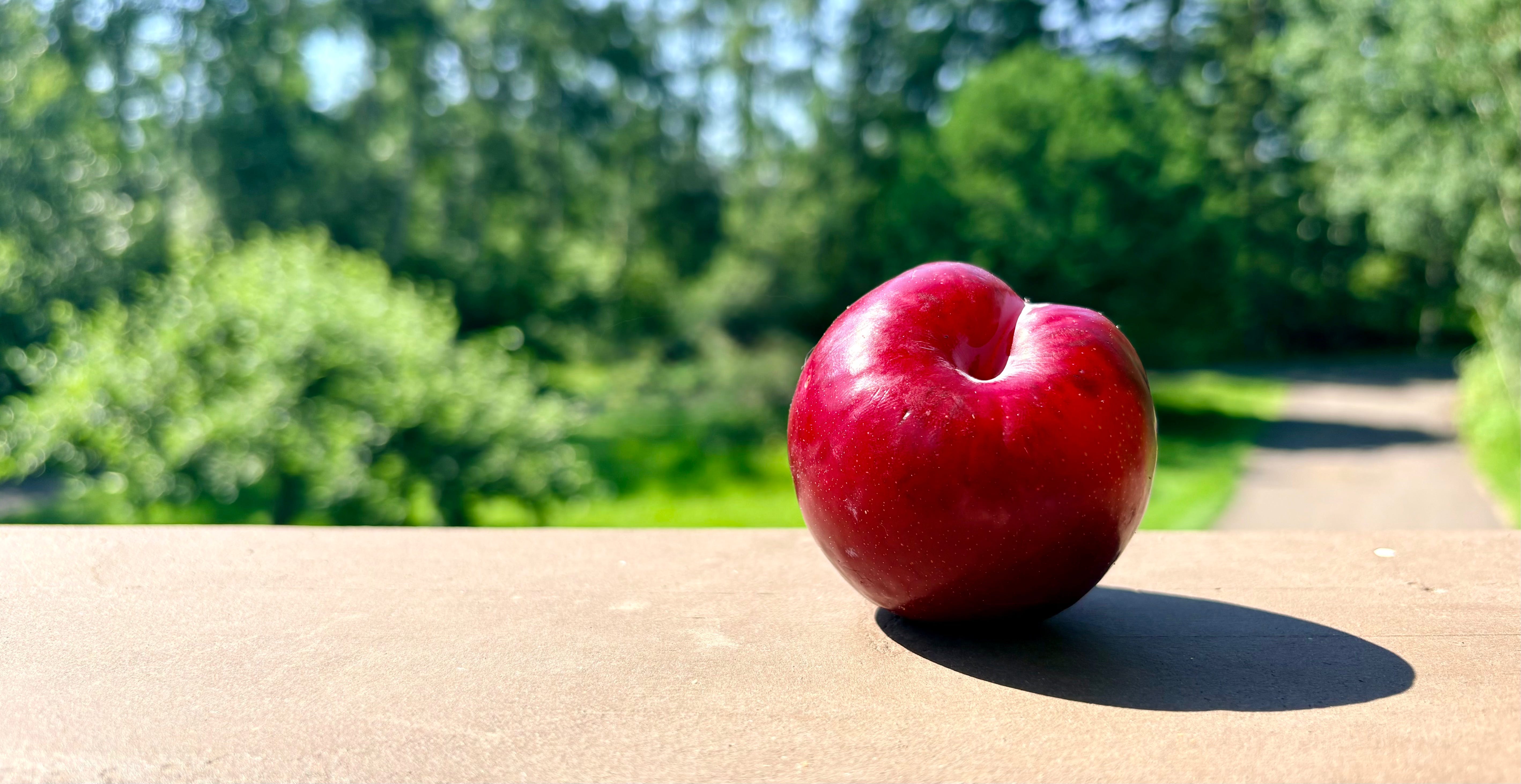
[Image ID: a real plum in the sunshine on my deck]
This is fantastic. "But I can always eat a plum." Bon appetit. 🌟
I was, of course, reminded of T.S. Eliot's self-conscious J. Alfred Prufrock: 'Shall I part my hair behind? Do I dare to eat a peach? I shall wear white flannel trousers and walk upon the beach.' Social anxiety expressed by one young man vs AI's voracious yet indiscriminate merging of facts or truths. Please keep at this interesting line of questioning!